
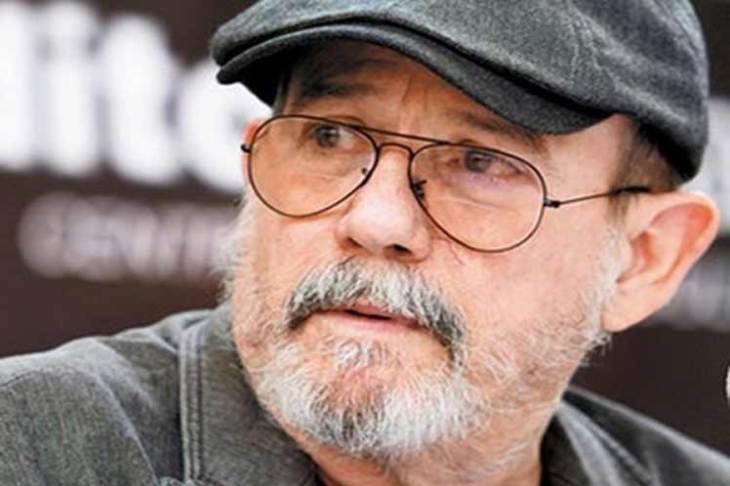
Silvio Rodríguez reflects on culture, national identity, and the challenges facing Cuba in an interview with editor Simón Vázquez, published by the Catalan newspaper ARA . The singer-songwriter shares his views on the Cuban revolutionary process and the role that external pressures and aggression have played in its development.
One of your latest songs, released as a single, is titled “Fireflies.” Although its content isn’t related to fireflies, these days Havana at night has seemed to us like a city of fireflies: tiny lights here and there. How are you experiencing the current tightening of the blockade measures?
We live constantly waiting for fuel to become available so we can power the generator at our Ojalá Foundation and continue our work; tracking down medicines for the sick; trying to help those who have the least. The doctors, who are our everyday heroes for their unwavering dedication, have had to finish surgeries using cell phone lights. There are tens of thousands of patients waiting for operations, including thousands of children. This is our daily life.
I want to clarify that “Luciérnagas” is not my song, but rather the work of the young and very talented Argentine singer-songwriter Milo J. I only added a small part of my voice to his song.
Specifically regarding Cuban music, what is its current state? Are the music schools, academies, and orchestras still operating? And how have the recent waves of migration affected Cuban talent on the island?
Due to power outages caused by the oil blockade, schools across the country had to close earlier than usual this year. It’s still unclear how the next school year will begin. The University of the Arts had to send its scholarship students back to their home provinces. The start of the next academic year is also uncertain. Some orchestras continue to operate under very difficult circumstances; public transportation is scarce due to fuel shortages, and people have been organizing tricycles as a temporary solution.
I lack the information to comment on the national impact of migration on music, although two of my regular musicians live outside of Cuba. We’re about to get together to prepare for the tour. That’s how we work. In other crises, when conditions have improved, the musicians and orchestras return. We’ll see if the same happens later.
What I can guarantee is the joy, the special feeling that any cultural activity generates, especially musical ones. From a symphonic concert in Havana Cathedral, to a song concert on the university steps, to the charming performance of a small children’s choir at the Vitier-García Marrúz House, a feeling of spiritual cohesion spreads, a feeling that embraces and accompanies people in their very difficult daily lives.
And where does Cuban trova stand today?
–I know there’s a television program that’s still on the air, and that some folk music venues are still operating. The poet and filmmaker Víctor Casaus, despite the current difficult circumstances, is trying to revive the Pablo de la Torriente Brau Cultural Center, where for three decades the production and recording of trova concerts was systematically organized, in addition to promoting the visual arts and book publishing. I hope he succeeds.
In “Sea señora” you sang: “To disenchantment, oppose desire. / Overcome the ‘r’ of revolution. / Restore what I see as decrepit, / but leave me Maceo’s arm / and, to guide it, his reason.” And on that same album, in “Bendita,” you sing: “I will ask the patron saint at the hermitage / to free us from the blockade and the troglodytes.” Who are you referring to as those “troglodytes”? What would need to be “restored” in today’s Cuba without renouncing Maceo’s reason?
–I was referring to the restoration of the pristine meaning of the Revolution, that is: a revolution of the people, by the people, and for the people; not for an all-powerful and mechanical bureaucracy. That is why I end by saying: “When wings become shackles / it is time to make the journey again / to the seed of José Martí.”
In “Tonada del albedrío” (Song of Free Will), from your album _Segunda Cita_ (Second Date), you say: “Guevara the human said / that no intellectual / should be a salaried employee / of official thought.” This year marks the 65th anniversary of _Palabras a los intelectuales_ (Words to the Intellectuals), the speech in which Fidel Castro maintained that Cuba would not have an official art—as socialist realism was in the USSR—and distinguished between revolutionary, counter-revolutionary, and non-revolutionary artists, the latter of whom should be granted the utmost creative freedom. What is your assessment of that cultural policy? What is the role of intellectuals in Cuba today?
–In the early years, some leading sectors longed to implement Stalin’s ideas in the USSR in Cuba. Fortunately, Che and Fidel were revolutionary intellectuals and did not believe in so-called Socialist Realism. Even so, our cultural policy has evolved over time. In the early 1970s, there was a particularly extremist period that Ambrosio Fornet described as the “Grey Five Years,” and that’s how it’s known. Fortunately, the Ministry of Culture was created afterward, with Armando Hart at its head. Another positive period was Abel Prieto’s first term as Minister of Culture. Both periods had strong support from Fidel, who took a keen interest in the issues facing the cultural sector.
Most of the intellectuals I know (people from the arts, but also from economics, science, and philosophy) tend to be people with their own ideas, often experiencing contradictions with reality, yet simultaneously possessing strong patriotic feelings. Many have managed to articulate their ideas and, whether they are heard or not, they consistently defend them. If we live in a society where we all should and can participate, I believe that is what is expected of us.
Your latest album opens with “América,” which ends with these verses: “May the light protect me / from America’s embrace, / from her gaze, / from her spell of love. / At dawn / America’s weeping is heard / and it resembles pain.” These lines remind us of the current situation: did you write them thinking of it?
“When I finished that song, several people asked me if America was Imperialism. And I think they thought so because of the moment when the protagonist has himself tied to the ship’s mast so as not to be swept away by irresistible beauty (an allusion to Odysseus when he approaches the Sirens). But it so happens that the song is dedicated to a neighbor of mine from decades ago, a beautiful and desired young woman whose name was America. And everything I recount happened to suitors who were driven mad by her beauty. From my window, near hers, I would hear her crying at night. That’s when I realized that beauty could sometimes seem like a solitary light bulb, surrounded by tiny insects attracted to the light.”
You maintain a tough, yet always constructive, critique. In “Para no botar el sofá” (To Not Throw Away the Sofa) you sing: “To pronounce the ‘we,’ / to complete the unity, / we will have to take the other into account, / the light and the darkness.” How do you assess the Cuban government’s latest measures to liberalize the economy?
–We come into a world, a reality built by many others over millennia. The least we can do is express what we think. That’s why my songs are the way they are. Sometimes even describing a landscape is critical. Criticism and self-criticism are present in family relationships and friendships, so how could they not be in society? It’s the most natural thing in the world.
The Cuban government’s measures were eagerly awaited by practically the entire country. Many things people were already doing spontaneously, out of necessity. I’d been waiting for these changes for over three decades. I think laws still need to be reviewed, even the Constitution. In the early 90s, I wrote some songs about our hardships. Here’s one:
TOWARDS THE FUTURE (1993)
Shadows departed towards the future.
Heading towards tomorrow, some darkness
He went to survive, because today’s sun
He couldn’t take it anymore.
The auroras will not be complete.
My complaints will shine through,
because what I so longed for
It will take time.
As much as I wanted to bless myself
and further purify myself,
I was flesh,
I was me.
What a hand lovingly did
Heartbreak broke him up with someone else.
I don’t believe it was in vain,
But it could have been much better.
Shadows departed towards the future.
When I can’t reach them, all I can do is warn them.
If anyone hears me there, don’t forget.
to illuminate.
His position has been firm in two recent statements: a video, which went viral on social media, in which he affirms, “I believed in the heart of Fidel and in the heart of Che.” What is his assessment of the Revolution and of Fidel’s figure on the centenary of his birth? And his now-famous request for an AKM to defend Cuba against a possible American intervention. Did he expect it to go viral?
The Cuban experience emerged alongside the most arrogant and cruel empire in human history; so much so that it has managed to shape the world and make it behave according to its interests. Those who do not comply are slandered, invaded, murdered, and dispossessed of their natural resources. It is almost a miracle that Cuba exists. For this reason, the Revolution has always had a great need for self-defense. This, in a certain sense, strengthens it, but it also creates conditions and can even foster a sense of ingrained behavior. I believe that the Cuban process would have been very different (and better) if it had not been so harassed and distorted.
I said that about Fidel and Che’s hearts ten years ago, when I was about to turn 70. Asking for a rifle to defend the sovereignty of my homeland is much older; it’s part of my very being, my atomic makeup. Cuba has always had to fight for its freedom, being a noble people who only wish to work in peace and prosper.
Your musical output is extensive: practically one album every two or three years since 1975. What is your assessment of this long career, now nearing 80 years? Do you have any new projects in the works?
“I’ve been writing songs fairly regularly for 65 years. I made the most of the first 30 years, especially. It was as if I knew that life gets more complicated and distances us from what we love most. I just finished ‘Anyone Born in Cuba,’ which I hope to share soon, and I have a few other things in the works…”
You will be visiting Catalonia this September. What message would you like to send to your Catalan fans?
To begin with, I have a Catalan son and a Catalan-Vietnamese grandson in Catalonia. So, you know. We’ll start our tour right in beautiful Barcelona, at the Gran Teatre del Liceu, where I’ll be meeting up with old and very dear brothers and friends.
Finally, we’d like to ask you about two tasks to which you seem to dedicate yourself daily. On the one hand, there’s your blog, which you update very often and which generates quite a bit of controversy both inside and outside of Cuba. On the other hand, there’s something that goes more unnoticed but is no less interesting: you always have a camera with you. What value do you place on photography, and how do you relate to it?
–As the first page of my blog, Second Date, explains, I started it to see what a blog was all about. It quickly became very popular and stayed that way for about 12 years, until I couldn’t take it anymore and had to shut down the “network.” For the last four years, I’ve been posting interesting things I pick up from my reading, along with the occasional piece of my own. I should clarify that I don’t agree 100% with everything I post. Sometimes I even disagree with almost everything. But I like to keep the ideas flowing.
My childhood unfolded in the 1950s. Around that time, news reports and “evidence” of extraterrestrial visitors, flying saucers, and other such phenomena began to surface. I knew then that a camera had to accompany me everywhere (no UFO was going to escape me), and as soon as I could, I acquired a very rudimentary one. Working in the press from a young age, meeting photographers, exploring darkrooms, projectors, and chemicals fueled my passion. Photography and the visual arts fascinate me.


You must be logged in to post a comment.