
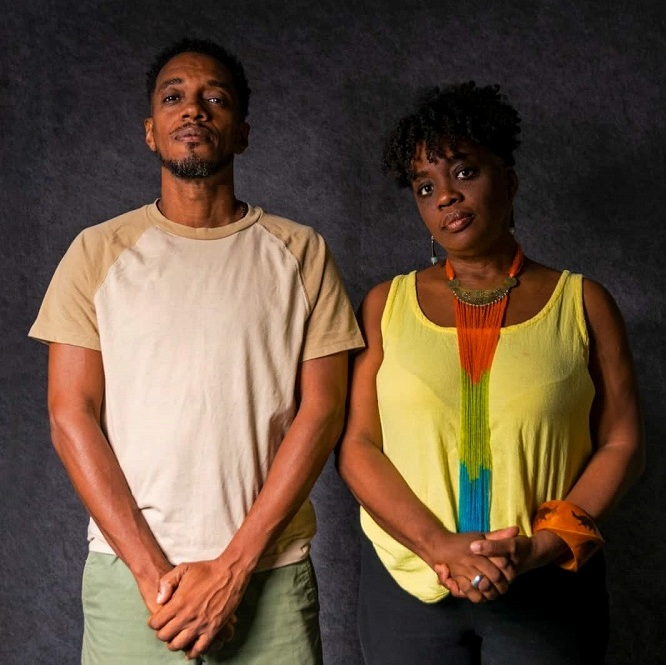
Magia López and Alexei Rodríguez—known as “El tipo este”—have dedicated 30 years to Obsesión, the project they founded to grow and make a contribution through music. They did so using hip-hop—often fused with jazz, rumba, funk, reggae, soul, and various African rhythms—while representing and championing the Afro-descendant experience in all its dimensions. With a unique and distinctive style, they have always worked from the heart, driven by a desire to build, construct, strengthen, enrich, and unite.
Why did you decide to form Obsesión within the hip-hop scene?
Alexei: “We come from a culture of street parties and heavy dancing—back from the days of street breakdancing—but by the 1990s, it was becoming harder for us to keep doing that.”
Magia: “And there weren’t many shoes to go around.”
Alexei: “We found the perfect tool for self-expression in rap. At the time, the names used by artists in the genre conveyed a certain darkness… *Bajo Mundo* [Underworld], *Tercera Roca* [Third Rock], *Apocalipsis* [Apocalypse], *Amenaza* [Threat], and so on. To set ourselves apart—and reflecting how we truly felt—we named ourselves Obsesión. It was supposed to be temporary, but in the end, it stuck.
“Rap feeds on current events and everyday life; the Cuban context has undergone many changes, and we feel compelled to express them. Furthermore, traveling extensively allowed us to gauge the pulse of the genre in other parts of the world, integrate ourselves into those scenes, and enrich our own work back home.”
Magia: “Roberto Fonseca served as the music producer for our first album, *Un montón de cosas*. We had actually been dabbling in jazz right from the start; that album is proof of it. We featured several guest artists and gradually made a name for ourselves.” “Then the path to independent production opened up, and we made *La Fábrik*. We delved deeper into social issues, participated in various festivals, and grew through hands-on experience—because there is no school for hip-hop. We had to learn a lot of things—rules for the stage, how to write lyrics and stand by them, and how to respect the audience.
“At the same time, it was a period when we connected with many musicians from other genres, as well as intellectuals and poets… people who really supported the movement at these festivals. Then came a phase of—let’s call it—consciousness-raising. Because it’s one thing to start with what you imagine, and another to realize the impact it’s leaving and become fully aware of that.
“We exchanged ideas with social science researchers; we began studying issues of gender and identity, for instance, and turned our song lyrics into a tool to help change behaviors, understand phenomena, and foster empathy…”
Alexei: “It’s important to understand that the discourse within academia—or among intellectuals in general—didn’t really reach the neighborhoods. The rap movement—and I’m not just talking about us, but the movement as a whole—brought people closer together; it bridged those existing gaps. So, many of our concerns reached a wider audience.”
Did *La Fábrik* spark or enrich the activism you began to develop?
Magia: “In a way, yes. It was a time when we balanced the artistic side with social commitment. *La Fábrik* was more than just an album; it was a beautiful project that took us into prisons, schools, and communities. We also created the Cuban Hip-Hop Symposia. That was the quintessential space that allowed us to educate others—and educate ourselves.”
Alexei: “Those were beautiful times because we met so many artists from different parts of the country who were using hip-hop as a tool. We all came together at the symposia, and we learned a great deal about civic engagement, popular education…”
Magia: “We deconstructed song lyrics… That was fundamental. Our messages had to be concise yet profound, and we had to shed the machismo that characterizes our society, championing causes against all forms of discrimination and violence… We grew and matured, without a doubt…”
Looking at the discography, *El Disco Negro* appears in the sequence, but at the same time, there is the album with the Frenchman Al Quetz, which features only Alexei…
Alexei: “We started recording it in 2013 and finished in 2018. In our own environment—our own home—we worked wonders with the beats that emerged. We did everything exactly as we wanted, and the result was *La Revancha de la Mañana*—and the vinyl release, too. Let’s say I worked from a place of individuality, beyond just Obsesión, because during that time Magia also took on a major undertaking.”
Magia, you directed the Cuban Rap Agency, brought greater visibility to women in the genre, and from that role, you tried to address the demands…
Magia: “I learned a great deal during that time, and the best part is that I apply it now. It was a journey of learning Obsesión has had…I acknowledge that mistakes are part of the process, too. Not having a background in administration caused me to stumble on many issues, but I learned day by day—because that is also what we artists want: to be led by those who can fully understand us—and I had to be consistent with that.”
Alexei: “I lived through that phase as her partner; it was extremely difficult, yet at the same time, it was an opportunity to realize—or rather, to confirm—the true worth of the person by my side. Managing a centre where almost everyone is male—while being a woman—highlights just how complex the situation must have been from every angle. Passing that test meant a lot to me because, even though Obsesión suffered from the limited time she could dedicate to it, I understood her perspective and supported her.”
*Luciérnaga: crónicas de luz* (Firefly: Chronicles of Light), their most recent album, won the Cubadisco Award this year in the Hip-Hop category. It once again showcases their work with jazz influences.
Magia: “We are thrilled with the award and what it represents for artists in the genre. We certainly had Albertico Lescay on board for music production this time, along with several guest artists; and although it took us seven years to finish—for various reasons—we consider it a very important album for us.
“That’s why we are focused on promoting it; we have videos released on our digital platforms, and the plan is to perform these tracks at our shows—especially the one we’re planning for Obsesión’s 30th anniversary. And I’m not just referring to the duo’s musical output, but to all the various projects we’ve dedicated ourselves to over this time.
“We have few albums, but we have a lot of music that hasn’t been included on any of them—music that has been very important to us and to our audience. I’m thinking of ‘Los Pelos,’ for example—a track written in 1999 for which we made a video in 2005. When we held our concert at the National Museum of Fine Arts theatre, we left it out of the set list, but the audience asked for it. Perhaps we’ll create new recording projects featuring those songs…” Are you satisfied so far?
Alexei: “There is always more to be done. You always find yourself saying, ‘Darn, we should have done such-and-such.’ But we’ll keep going; we won’t stop. Besides, the greatest reward is staying together.”


You must be logged in to post a comment.