
The Gibara International Low-Budget Film Festival, July 14 to 18, brings together nearly twenty countries for its 20th edition and maintains its essence as a platform dedicated to creativity and diverse low-budget films, originally founded by renowned Cuban filmmaker Humberto Solás. Over the last 20 years, the Festival has established itself as a space for cultural resistance and a platform for fresh cinematic perspectives.
The event was initially postponed but the decision was ultimately made to hold it in the summer to encourage greater participation among students and young people. This year there is an increased focus on open-air screenings across three screens set up at various locations in Gibara, using a battery-powered system to prevail in the event of power cuts.
The event includes competitions in fiction, documentary, and animation, alongside exhibitions, concerts, academic forums, and dance and theatre performances.
Competing titles include the Spanish film Vértigo, the Argentine Memoria de infancia, the Honduran Cubeta, the Curaçaoan En vísperas, the Brazilian Bestia del vientre, and the Cuban-Spanish co-productions Primera enseñanza and Pupa, among other short films reflecting the diversity of the Global South.
Documentaries in the competition include Pintemos de violeta la economía cubana… para que ninguna quede atrás (Let’s Paint the Cuban Economy Violet… So No One Is Left Behind) by Lizette Vila, Sergio Cabrera, and Ingrid León, and Muñequita Linda by Spanish filmmaker David Moncasi. These two works explore themes ranging from Cuban reality to deeply personal life stories.
The festival opens with the open-air screening of, Neurótica anónima, by renowned Cuban filmmaker Jorge Perugorría, starring Mirta Ibarra.
Discussion panels include “Community Filmmaking: Co-designing the tourism Gibara deserves” and “The ‘Cine Pobre’ Factory: Challenges and results of the journey so far,” as well as special showcases from guest festivals like FECISO and ECOZINE.
* * * * * *
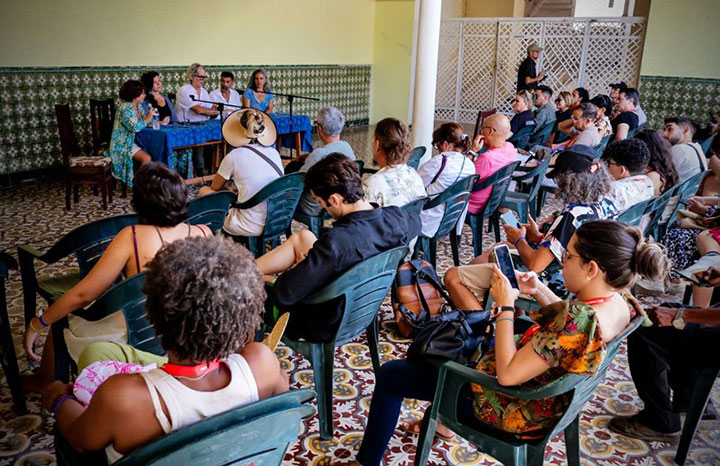
The panel ‘Low-Budget Film Factory: Challenges and Results Along the Way’—held as part of the 20th edition of the International Low-Budget Film Festival (Festival Internacional de Cine Pobre) in Gibara—brought filmmakers together to analyze the initiative’s impact in raising the profile of cinema from eastern Cuba.
Event president Sergio Benvenuto Solás explained that the decision not to hold the ‘Factory’ during this edition stems from a desire for growth, with the aim of expanding possibilities for future editions.
He emphasized that the initiative advocates for creating alternatives in this part of the island—where accessing cooperation funds (which tend to be concentrated in Havana) is more difficult—and acknowledged that establishing a common fund remains an unfinished task; this fund should involve not just Holguín, but the various cultural structures across the five eastern provinces.
Osmanys Sánchez Arañó, a documentary filmmaker from Santiago de Cuba and winner of the first edition with his project Llave de paso (Stopcock), stated that the Factory is significant as a cultural event because it seeks to give visibility to a region of the country that has long been subject to the dynamics and narratives of a capital-city cultural hegemony.
Filmmaker Ivette Ávila outlined the difficult situation facing independent filmmakers, noting that accessible funding in Cuba is extremely scarce; institutions have dwindling budgets for grants, creating a critical situation.
Alexis Triana, president of the Cuban Institute of Cinematographic Art and Industry (ICAIC), announced new developments regarding the Cuban Film Development Fund.
He stressed that any initiative not grounded in management capacity is bound to fail sooner or later. He noted that the mechanism currently operates solely on a state budget, making it essential to develop management capabilities to replenish its coffers.
Triana added that ICAIC maintains three film sets in the country powered by battery banks and solar panels, and highlighted that there are 75 registered independent production companies in Cuba—a source of pride for the institution. It also raised the need for the country’s movie theaters to reopen through partnerships with non-state chains and agreements with workers, in defense of the existence and utility of these buildings and their contribution to society.
The panel demonstrated a consensus on the need to strengthen ‘La Factoría’ as a tool for decentralization and the empowerment of film production in the eastern region, within a context where independent creation and resource management stand as key challenges for Cuba’s film sector.
Read the original report by Cuban News Agency ACN in spanish


You must be logged in to post a comment.