
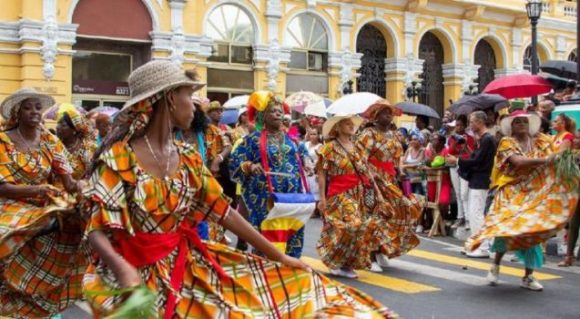
The 45th edition of the Caribbean Festival took place this year 3-5 July in Santiago de Cuba in a special format adapted to the country’s current conditions, yet driven by the determination to preserve one of the most important celebrations in Cuba and the region.
Daniela Anaya, a member of the Organizing Committee, noted that despite the limitations, holding the event—also known as the Fiesta del Fuego (Festival of Fire)—is highly significant; it demonstrates a commitment to the uninterrupted continuity of a gathering that serves as a benchmark for local, national, and Caribbean identity.
Before the event she explained that while the bulk of activities would be concentrated within those three days, some traditional events would still take place on their usual dates—including the Ceremony of Slave Rebellion, scheduled for July 7 in the town of El Cobre.
She stated that this would be an atypical edition marked by numerous challenges, meaning the traditional parades and the gala for the guest of honor—Colombia—cannot be held; nevertheless, spaces dedicated to the cultural expressions of participating nations will be guaranteed each day.
The traditional ‘Quema del Diablo’ will be moved to the Portuondo community to preserve this emblematic festival practice, while activities will also extend to neighborhoods in the Abel Santamaría and Nuevo Vista Alegre districts.
According to Orlando Vergés, president of the Organizing Committee and director of the sponsoring institution Casa del Caribe, the artistic program would take place primarily between 3 and 7pm to facilitate public mobility and encourage participation.
He affirmed that this edition would pay tribute to the essence of the Caribbean Festival and its founders, while acknowledging the efforts of the groups, projects, and institutions that helped make the event possible despite the complex circumstances. Around 70 international guests from some ten countries—including Argentina, Brazil, Colombia, the United States, Haiti, Mexico, and the Dominican Republic—would participate, alongside representatives from the embassies of Romania, Azerbaijan, and Egypt in Cuba.
The program would feature workshops on theatre, folk religion, dance, visual arts, and poetry, as well as—for the first time—a space dedicated to food culture.
Additionally, the “The Caribbean That Unites Us” colloquium—the festival’s main academic event—would host an opening lecture by Colombian journalist Orlando Oliveros, the presentation of a project on Latin American and Caribbean critical thought, and the launch of the call for participation in the First International Meeting on Digital Culture in Cuba and the Caribbean.
Holding the Caribbean Festival under current circumstances goes beyond merely presenting a cultural program; the event serves as a space for exchange among the region’s peoples, the preservation of folk traditions, and the practice of international solidarity. These values have distinguished this Santiago-based event for over four decades, and today it reaffirms its enduring relevance as one of the premier gatherings in both the Caribbean nation and the wider region.
Based on original report by CubaDebate in spanish
The Fiesta del Fuego aims to “celebrate cultural diversity and strengthen the bonds among Latin American and Caribbean peoples.”


You must be logged in to post a comment.