
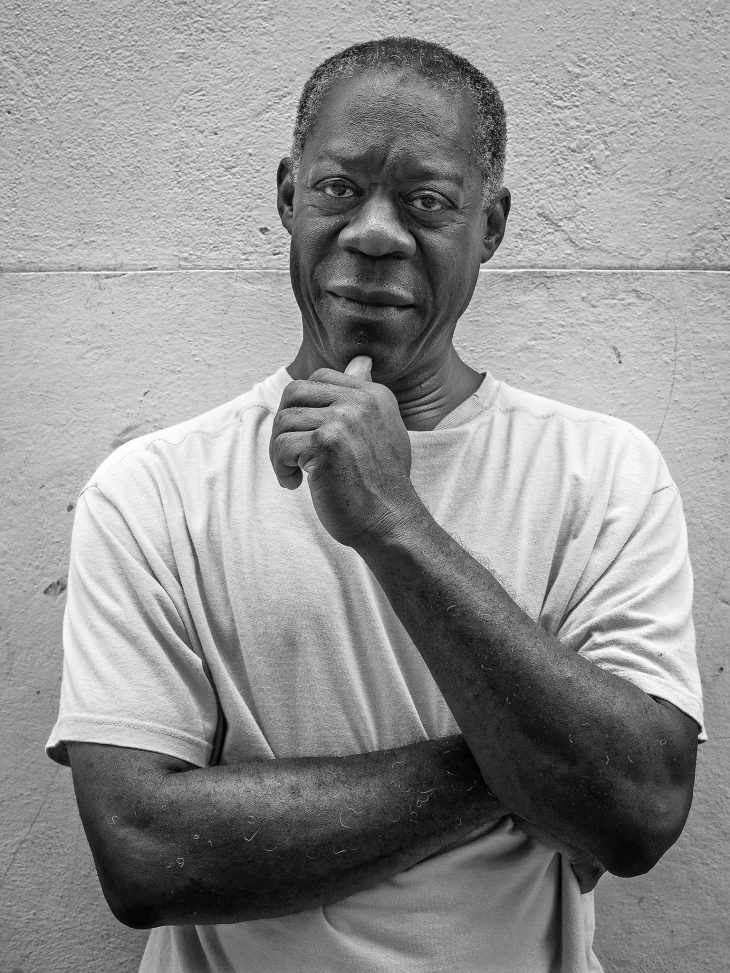
Eduardo Roca Salazar, known throughout the world as Choco, one of Cubaʼs most celebrated contemporary artists, died in Havana on 16 April 2026 at the age of 75.
Born in Santiago de Cuba in 1949, Choco lost his Haitian-born father at an early age. A schoolteacher recognised his artistic talent, but it was the Revolution that enabled him to develop it. Reflecting on his education, he recalled how Fidel Castroʼs creation of the School of Art Instructors opened opportunities for young people from working-class backgrounds, training artists who would take culture “to those who had none.”
Conscious of the important legacy of earlier generations of Black Cuban artists – such as Wifredo Lam, Roberto Juan Diago, Benny Moré, Nicolás Guillén – Choco was clear the Revolution’s role, alongside arts education and institutions, was to strengthen and extend that “freely and at no cost – to everyone.”
He spent two decades working at Havanaʼs Experimental Printmaking Workshop, where he cultivated his many techniques. In the 1990s, when artists struggled to source materials, Choco embraced ‘collagraphy’ – a recently developed printmaking process. Choco used waste such as tin cans, fragments of walls, wood, or scraps of old tablecloths, arranged on a cardboard base he covered in a paste that hardened, then added paint or ink to make prints.
“My creative work is fuelled by my countryʼs way of life,” Choco said. “My people themselves, the human figure, the way people are, how they think, speak and walk. My fundamental inspiration comes from the city – from Old Havana, with its colours, its walls, its cathedral and its music.”
In interviews Choco explained: “I don’t practice any African-derived beliefs, but it’s part of my upbringing.” “I’m not a (Santeria) practitioner but culturally I am dedicated entirely to it – because that is my culture, that is my education… We (Cubans) are all a mixture…I believe I am reflecting man universally in each of those faces.”
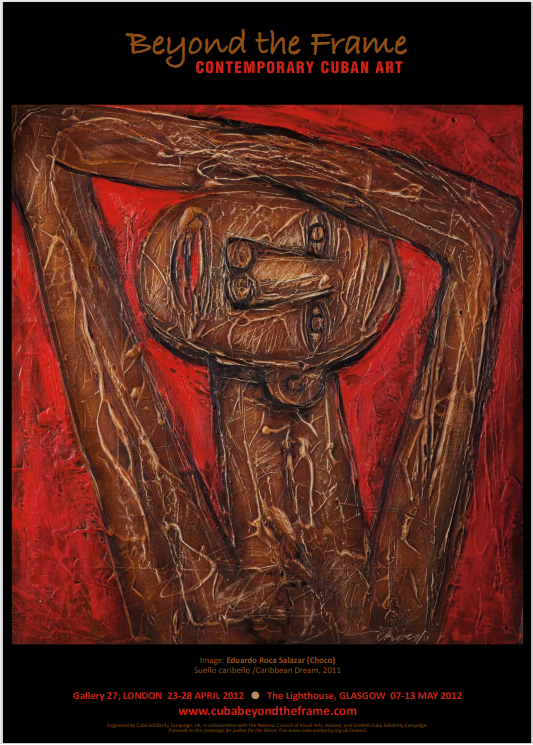
In 2012, Choco travelled to Britain for Beyond the Frame, an exhibition in London and Glasgow organised by the Cuba Solidarity Campaign to raise funds for the campaign to free the Cuban Five, then imprisoned in the US for fighting terrorism. He donated a collagraph and a set of screen prints, and one of his works featured on the exhibition poster. Speaking about the image, he said: “This is part of a series I have been working on dedicated to silence, to loneliness… Every one of us has felt these conditions at some point in our lives.”
Choco dedicated his life to creating and teaching, influencing generations of artists both inside and outside of Cuba. He taught in Havana, Spain and the United States. A member of the National Union of Writers and Artists of Cuba, he exhibited widely across the world. His work is held in major international collections, and he received numerous honours, including Japanʼs prestigious International Print Triennial Kochi Award in 2000 and Cubaʼs National Prize for Visual Arts in 2017.
Documentary clip – CHOCO
Documentary produced and directed by Juanamaria Cordones-Cook. Choco (2014), ca. 29 minutes long with English subtitles.
MUSIC and Choco
Watch this video for a glimpse of Choco at work. Cuban musician José Luis Cortés (El Tosco) improvised a 14-minute musical piece as a gift to Eduardo Roca (Choco) in 2025. This is a fragment, edited with images, mostly from the 2016 documentary about Choco “The Man with the Broad Smile and the Sad Gaze,” Directed by Pablo Massip.
 Cuba 50
You must be logged in to post a comment.