
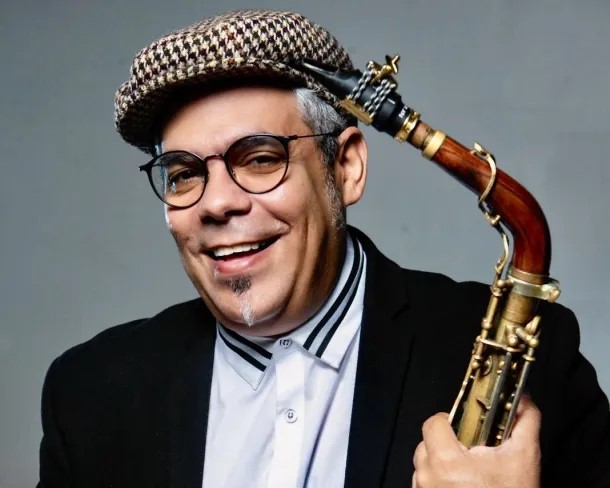
The Cuban saxophonist and composer reflects on the identity and roots of Cuban jazz, and on why no algorithm will ever replace a human soul on stage.
César López grew up in Florida, Camagüey, in central Cuba, and first heard the American saxophonist and composer Charlie Parker when he was eleven. That encounter changed everything. He won Cuba’s national saxophone competition at thirteen, studied at Havana’s National School of Art and the Higher Institute of Art and, in 1988, at nineteen, was selected by Cuban pianist Chucho Valdés to join Irakere, the group that defined Afro-Cuban jazz for an entire generation. Nine years of touring followed on major stages around the world, sharing bills with Miles Davis, Herbie Hancock, Chick Corea and Michael Brecker. In 1997 he founded Habana Ensemble, with which he has earned several Grammy nominations. Today, from a restored 19th-century building overlooking Havana Bay, he directs the César Jazz Club, a project he describes simply as “a temple for Cuban jazz.” On the occasion of International Jazz Day, on 30 April, he spoke with UNESCO.
It is often said that jazz is not only music, but also a way of life and a way of thinking. When did it become that for you?
Jazz is a style. Musicians who devote themselves to this music incorporate it into daily life, as something everyday, something necessary. I became interested very early, around the age of eleven, when my teacher Mario Lombida, at the Luis Casas Romero conservatory in Camagüey, played me the first jazz recordings I ever heard. The first thing I listened to was Charlie Parker. That sparked such a deep interest that I immediately began trying to figure out some of his solos.
What does jazz give you that no other musical genre has been able to give you?
I studied classical music at the conservatory, and I’m deeply grateful for it. Classical music is like the mother of all music, and understanding it is fundamental. But jazz, especially through its main distinguishing feature, improvisation, opens other paths, other horizons. It opens a completely different mindset.
For me it is a supreme music. It doesn’t only teach technical skill, which you also learn through classical music, but a different mode of creation: improvisation is simultaneous composition. That is what sets it apart from everything else.
Is there a recording that crystallized that love for jazz?
There are many, but one album influenced me more than any other, one that overwhelmed me and made my interest grow even stronger: Charlie Parker with Strings. For me it is a masterpiece, an essential record. I can listen to it many times and I always receive the same emotions, and new ones as well. It was extremely important in my love for jazz.
Cuba has a deep and distinctive relationship with jazz. What makes Cuban jazz unmistakable within the wider tradition?
Cuban jazz is a real phenomenon, a genuine style within the broader world of jazz. It is a style that did not originate in Cuba, but in New York; it was created by Cubans who emigrated there. It is essential to mention those who began that work: Machito and the Afro-Cubans, Mario Bauzá, René Hernández, Chico O’Farrill and Chano Pozo.
What most distinguishes Cuban jazz is the rhythmic blend, the incorporation of Cuban rhythms into the language of jazz. That rhythmic distinction is what gives it its unmistakable character.
You joined Irakere at nineteen, under the direction of Chucho Valdés. How did the great musicians of the global jazz scene react to that Afro-Cuban synthesis?
Being part of Irakere gave me the privilege, at a very young age, of playing at the most prestigious festivals and clubs in the world, and of seeing up close musicians I might never have imagined meeting: Miles Davis, Herbie Hancock, Chick Corea, Michael Brecker, Freddie Hubbard, and many others. The reaction of those great musicians when they heard that blend of Afro-Cuban rhythms with jazz was incredible. They experienced it as something deeply authentic. Cuban jazz exists not only as music, but also as a social and cultural event.
UNESCO declared 30 April International Jazz Day precisely because of jazz’s ability to build bridges between cultures and generations. Do you share that conviction?
I think it was a magnificent decision, and UNESCO deserves enormous credit for that determination, as does Maestro Herbie Hancock, one of the great ambassadors of music. We are talking about a music that is made and cultivated across the entire planet, and that fuses with rhythms from the most diverse countries. Jazz has created an exquisite cultural exchange: it has led cultures to connect with one another and has created spaces where even friendship is strengthened. It does not matter where you were born, the music of your country merges with jazz, and that creates something bigger. Look at the jazz festivals that exist today in virtually every country in the world. And jazz has also been a symbol of peace.
Artificial intelligence is already being used to compose and produce music. What risks do you see for artistic creation?
I do not see it as a threat, because it will never be able to replace the human being. No matter how extraordinary the things it produces may be, artificial intelligence will not be able to replace the feelings a human being conveys. If anything, I think the opposite will happen: the more these technologies grow, the more value and interest jazz will gain, precisely because it is more human, because it is directly connected to human emotion, not to algorithms.
Jazz draws strength from the dialogue between tradition and innovation. How do you see that balance in the new generation of Cuban musicians?
I see it very clearly, and I’m seeing it here at the César Jazz Club, from Tuesday to Sunday. Cuba has always produced an extraordinary pool of jazz musicians, even at a universal level. What impresses me is how young people, even in conservatories, are making music at a very high level, with a maturity that sometimes I did not even perceive in my own generation. The health of jazz in Cuba is very strong. It is assured.
International Jazz Day
Established by UNESCO’s General Conference in 2011 and recognized by the United Nations General Assembly, International Jazz Day brings together countries and communities around the world every 30 April. The annual celebration highlights the power of jazz and its role in promoting peace, intercultural dialogue, diversity and respect for human dignity.
International Jazz Day has become a global movement that reaches more than two billion people every year across all continents through educational programmes, performances, community outreach, radio, television and streaming, as well as digital and print media and social networks.


You must be logged in to post a comment.