

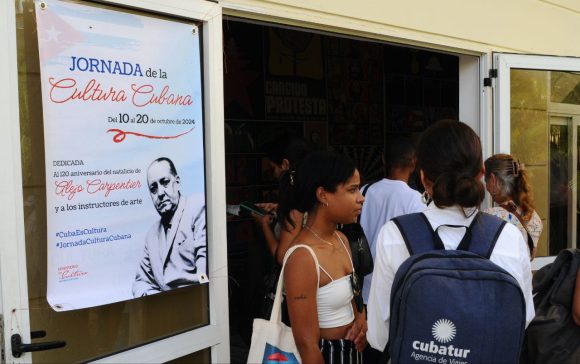
In Cuba celebrations for the national Day of Cuban Culture begins 10 October and extends until the day itself – October 20. This year it is partly dedicated to the 120th anniversary of the birth of the writer Alejo Carpentier* and also to art instructors**, young people trained to teach arts and culture in primary schools and community-based projects across the island.
In Havana, the celebrations began with the premiere of a new documentary ‘Community’ about the National Folkloric Ensemble of Cuba, by filmmaker Claudio Peláez. The Association of Haitians in Cuba will pay tribute to Carpentier with performances in 14 residential areas, parks, spaces and cultural institutions, along with other folkloric groups.
On October 11, songs were sung in every school to remember the legacy of musician and composer Joseíto Fernández (1908-1979, composer of ‘Guantanamera’) on the 45th anniversary of his death.
Across the country activities have included concerts, book presentations, screenings, as well as lectures by renowned intellectuals and artists.
According to the Deputy Minister of Culture, Lizette Martínez, for this day the spotlight is on culture in the community and the main cultural institutions of the nation are looking to promote that. Martinez also highlighted the role of art instructors, who have made such a great contribution to art education in schools throughout the country.
On October 20 itself, the eastern province of Granma will host the traditional event for the anniversary. Each year, this day pays tribute to the first singing of ‘La Bayamesa’, by Perucho Figueredo in 1868 at the beginning of the Wars of Independence, the song that became the national anthem.
In the central province of Villa Clara there will be a tribute gala dedicated to art instructors. Symphony orchestras in all provinces are performing programmes to honour the Cuban writer Alejo Carpentier, with works by important composers such as Amadeo Roldán and Alejandro García Caturla, whom Carpentier studied so much for his writing on Cuban music.
From October 10 to 20, 19,160 activities across the island are expected, involving 2,240 institutions and 2,000 communities.
“The Day is an opportunity to draw attention to efforts for the protection of heritage, while showing school as a place of cultural integration and to emphasize the role of Cuban culture as a symbol of resilience and diversity,” says the press release of the Ministry of Culture.
Adapted from Prensa Latina report in Spanish
*More about Alejo Carpentier
Alejo Carpentier was a Cuban novelist, essayist, and musicologist who greatly influenced Latin American literature. He was born 26 December 1904 to French-Russian parents in Switzerland but he grew up in Havana and lived there most of his life, defining himself as Cuban. He was very interested in Latin American politics and supported the Cuban revolution.
Carpentier wrote a key book about Cuban music La música en Cuba, and incorporated Afro-Cuban culture in his various writings. He tried many forms of writing – journalism, radio drama, scripts for plays, academic essays, opera and libretto, but it is his novels for which he is best known, one of the first practitioners of magical realism. The most famous example was Carpentier’s 1949 novel El reino de este mundo (The Kingdom of this World) about the Haitian revolution in the late 18th century.
Carpentier’s writing style combined what was called the New World Baroque style (itself a fusion of European with Latin American artistic styles) with his own view of French Surrealism. Influenced by his many travels, he wove elements of Latin American political history, music, social injustice and art into his writing, which greatly influenced younger Latin American and Cuban writers. He died in 1980.
**The José Martí Art Instructors Brigades emerged in 2004, an organization that trains and inspires young people doing their social service as art instructors to children and young people in schools and communities, to broaden participation in making Cuban culture with the aim to encourage art and critical thinking across the island.
 Cuba 50
You must be logged in to post a comment.