
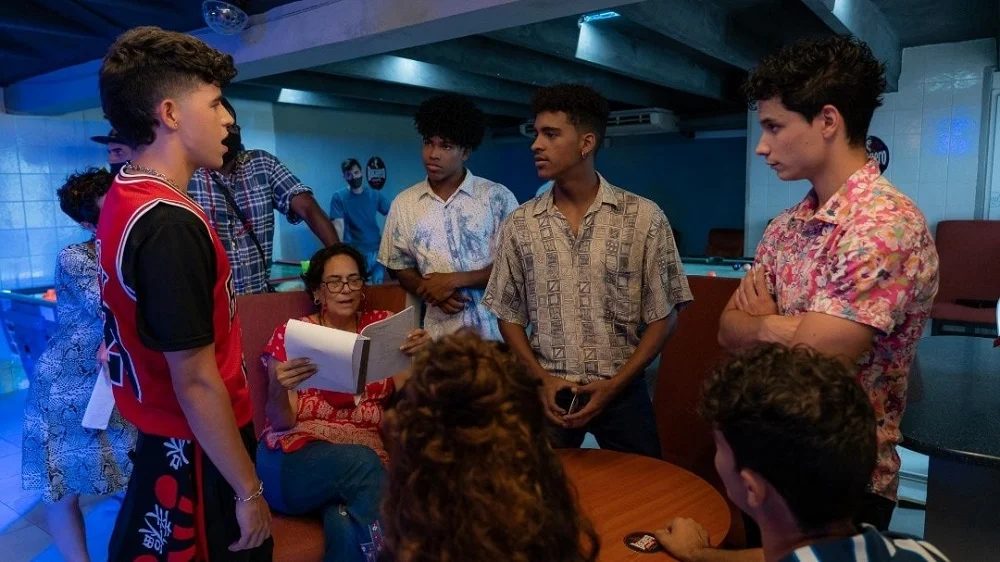
The Cuban TV drama series Calendario (translating as Calendar or Diary), directed by Magda González Grau and written by Amilcar Salatti, was a big hit with the public throughout its three seasons which ended in May this year, reportedly thanks to “a coherent discourse, reflected from a deep empathy and sensitivity”. Calendario talks about and to young people, about their relationships with each other, school, teachers and family. It was the first TV drama series produced independently in Cuba, made for Cubavision.
In the opinion of the filmmaker, González Grau, more dramas should be produced in this way. “We have approached all the issues without wanting to attack any audience, but with the intention of making them reflect,” she said in an interview on national TV.
It has triggered a lot of public discussion on social networks (247k followers on Instagram, 24k on Facebook @calendarioserie). The drama features stellar performances by experienced actors Osvaldo Doimeadiós, Patricio Wood, Roberto Perdomo and Mayra Mazorra, together with the young actors, and a character who sympathizes with the young people and their extraordinary talent: Professor Amalia, played by Clarita García.
Situations related to addiction, sexuality (including possibly the first lesbian kiss on Cuban TV), racism, prejudice, paedophilia, among other topics, have been portrayed in this production that has been watched avidly by many Cuban households every Sunday evening.

When asked in an interview published in La Jiribilla whether she was satisfied with the third season of the drama she said:
“There are always things I could have done differently, or better. I wouldn’t have let myself be pressured by time, by the difficult conditions of some locations, especially for sound, but I’m very happy with the response of the public.
We are all very happy with the reception and reaction of the viewers. People follow each episode and are very aware of the development of conflicts. I like that the series is controversial. I feel that this season gives closure to the development of conflicts and characters.
The audience has got used to the way we have raised the issues and has come to accept them, which is great because they are topics not intended to provoke rejection or attack anyone, but for the public to reflect and help make our society better.”
When asked for the reason for the success of this series, the director said that it is achieved when you connect the viewer with reality. That people believe the things that are being represented on the screen.
“Fiction is constructed; It’s not like in a documentary. You have to make what you present believable and make whoever is watching you emotional when they see their own problems reflected.
“Cuba, like the world, is going through very difficult times, because of shortages, because of the problems that derive from this unstoppable blockade. People need that connection. Thinking about what can be better and that being happy does not depend on others, but on oneself. I think that’s where the success of Calendario, and its merit of connecting with almost all audiences, lies,” explained González Grau.
Grau is also general director of the youth space on Cuban TV: ‘Una calle, mil caminos /One street, a thousand paths’ which was first established in 2010 and set to start a new season in July. In an interview she was asked what new things are coming this year?
“I am very excited, because this year we will present excellent music and programmes with stories that are worthwhile, by new directors and more experienced ones. They explore identity, shyness and complexes in adolescence, fear of failure, the formation of new family nuclei, and many others.
“We are making the programmes with production company Patria, directed by Roly Peña, which has been a good decision, because Roly, being an artist himself, has become a facilitator of the processes and understands the needs of each production, despite low budgets. Some pieces were recorded in Cienfuegos, Trinidad and Managua with the support of the local authorities. Not just filming in Havana.”
She is also in the post-production process of the TV drama Invisibles, written by Amílcar Salatti, which will premiere in Una calle, mil caminos. This new drama tackles youth suicide and homelessness. She says:
“The problem of suicide in young people attracts a lot of attention, because we talk about how to live life. It’s important to be clear about how much life is worth and why it’s important to live. Even if there are problems, difficulties, life is a gift, a miracle, and it is a blessing to be able to live it, even if it hurts. Living is something that must be defended. I think that young people should be clear about these concepts.”
Based on report by Prensa Latina in Spanish here
And on the Interview with the director in May 2024 by La Jiribilla in Spanish here
Watch a video of the audience comments about the Calendario series at a special viewing of the final episode at the end of May 2024
 Cuba 50
You must be logged in to post a comment.