

With the naturalness of someone who seems not to have received awards, let alone the 2024 National Film Award, nor to have appeared in films nominated for awards at the Oscars and Cannes Film Festival, Jorge Perugorría, known as ‘Pichi’ (born Havana, 1965), was interviewed recently by a team of Cuban journalists for ACN.
Surrounded by printed T-shirts, he welcomes us into his workshop/gallery Galería Taller Gorría (GTG), with a cigarette in one hand, while in the other he holds a refreshing drink that the staff from Bar Yarini upstairs have given him to combat the heat.
Recorders ready, camera too. We give the go-ahead to the star who, carefree and sitting on some stairs, begins to narrate the film that has been his life.
Silence, cameras rolling… action!
Scene 1. Pichi, a hidden talent of Wajay
“I was born in Wajay (a suburb of Havana) and I come from a humble family, of workers, where no one had had an inclination towards art and they never took me to the theatre or anything. I discovered that myself,” he said.
“In that little town there was a baseball field where I used to play, and from among those players emerged Orlando ‘El Duque’ Hernández. One day we decided to go to the Casa de Cultura (local community arts centre) and there I learned about art; painting, above all.”
For this artist, who started in an amateur theatre group while he was in high school, moving through the world of the stage is “the best way to train as an actor.”
“Of course the academy is important, but in my case as an amateur it was something organic and little by little I found ways to develop a vocation for something that I was passionate about and where I could express myself. I couldn’t even study at the National School of Art or at what was the Higher Institute of Art (today the University of the Arts) because I didn’t find out about them, and when they made the call, I had no motivation.”
Perugorría did not become an actor until 10 years after that amateur debut on the stage.
Scene 2. A lucky day
In his own words, and after a decade dedicated to theatre, he only saw the world of cinema as a spectator.
“It has been difficult for me. I’m a big theatrical and I enjoy overdoing it. I like to put the strength and passion that theatre has into cinema. I love to put together my drama in front of the cameras, although each time acting goes down another path that, like it or not, I have also travelled,” he confessed.
His first experience was with filmmaker Tomás Piard (1948-2019) in the short film Boceto (1991).
“Cinema was a radical change in my professional life because I not only began to work with two great masters such as Tomás Gutiérrez Alea known as ‘Titón’ (1928-1996) and Juan Carlos Tabío (1943-2021), but also on one of the films with the greatest impact in Cuba and that opened doors for me on an international scale: Strawberry and Chocolate (1993).”
Perugorria, like the Diego he soon portrayed, had his lucky day when he found the wonder of the big screen.
“I was working in two plays and Mirtha Ibarra, Titón’s actress and widow, told me about the casting for the film, but I told her that they had not called me. She introduced me to Titón and he told me that he would call me, but I never imagined that they would give the part to me, rather than to others more established,” he recalled.
Like those of his generation, Pichi understood that he was closer to David’s role; however, that part was already in the hands of actor Vladimir Cruz.
“In the play in which I was working with Carlos Díaz at Teatro El Público I played a female character. I suppose I had very fresh features and mannerisms suited to the role that Gutiérrez Alea was looking for.
“Carlos, who had also auditioned for Diego, prepared me for the character. They called me a month later to tell me that I had been chosen. That’s when the hard graft began with Titón and Tabío, those great masters with whom I discovered a way of making films that has marked me to this day,” he said.
It was then that one of the characters of Senel Paz, screenwriter of the film, took on a face. The script was based on his story ‘The Wolf, the Forest and the New Man’ (1990), a story of possible friendship and love in the 80s in Cuba, beyond the differences between a young communist militant and a religious homosexual, patriot and devotee of Jose Lezama’s poetry.
“Thanks to this, I embarked on a journey in Latin American cinema that I had begun to love and know through the Havana film festivals,” Perugorría said.
His final embrace with David, while the masterful music of Cuban pianist José María Vitier plays, qualifies among the most moving and iconic scenes of Cuban cinema.
Scene 3. From Strawberry and Chocolate to the World
Strawberry and Chocolate received numerous national and international awards, and became the first Cuban film to be among the nominees for the Oscar Award for best foreign film in 1994. Although it did not win, the feature film by Titón and Tabío set the bar high for the island’s film industry.
But it could be said that this film catapulted Pichi to the big screen regionally and worldwide.
“I never imagined that I would end up making three films in Brazil, five in Argentina, in Chile, two in Colombia, throughout Central America, the Dominican Republic, Costa Rica, Panama, Mexico, Puerto Rico, Spain and Portugal. At the festivals I met many actors and directors with whom I worked later,” he explained.
Perugorría also feels that the doors of Spanish cinema opened for him, because he has been in more than 15 productions from that country, which he considers his second home and is already a member of its Film Academy.
“It has been a journey of learning because I have discovered the culture of several nations that has enriched me as a human being, as an artist, and has increased my commitment to give back to my island everything it has given me.”
Pichi commented during this interview that sometimes people ask him if he retired from acting, due to his absence on the Cuban screen, but he explained the opposite is true.
“I do work outside of Cuba and unfortunately the films do not reach our audiences. Recently, a very interesting series I did in Barcelona called Doctor Portuondo (2021, Filmin) was broadcast, and I participated in another production in Spain, Las noches de Tefía (2023, Atresplayer), about the concentration camps in the Franco era, when homosexuals were taken to the Canary Islands. I have just been in another TV series in Mexico with Gael García Bernal and Diego Luna as protagonists dedicated to the world of boxing,” he detailed.
“In my homeland I have starred in the series Four Seasons in Havana (2016, Netflix), based on the quartet of novels by the writer and National Awardwinner for Literature (2012) Leonardo Padura, directed by Félix Viscarret and with a script by Padura himself and Lucía López Coll.”
He claimed that he would love for those four episodes – which could well be described as four films in themselves – to be broadcast on national television, as they are the work of one of the most notable novelists in the country.
The actor has on more than a few occasions taken on characters that have their origins in literature.
“I have had a very important relationship with literature in my career. Diego, in Strawberry and Chocolate, and Mario Conde, from Padura’s detective saga, come from books and are possibly the most beautiful characters I’ve played in my career.
“Normally, with well-known characters, people have a reference, a vision. Each reader builds a world about them; for example: Padura never talks about Mario Conde’s physical characteristics, but he does talk about his Cubanness, and that is what is emblematic. Conde is fascinating: a loser in love, but with other virtues such as his passion for literature, a sense of friendship, honesty, loyalty; he’s just a lovely guy.
“Every reader put a face to this policeman. I don’t know to what extent I am influenced by him, because we agree on many things: the love of baseball, of friends, of Cuba,” he said.
Pichi said that a few months ago, while he and Padura were presenting a film based on the writer’s texts, Padura told him that he had a great responsibility because he was already the face of Mario Conde.
Regarding the literature-cinema link, he highlighted his ties with Gabriel García Márquez, of whom he interpreted his Oedipus alcalde (1998); as well as with the writer Luis Sepúlveda (1949-2020), author of Nowhere (2002).
Scene 4. Pichi as director. Clapperboard, sound, action!
Jorge Perugorría has other passions, and it is very easy to see this because on the walls of the Taller Gorría Gallery (GTG) bloom ‘Sunflowers for Diego’, his most recent exhibition of paintings, which in 2023 he dedicated to the 30th anniversary of ‘Strawberry and Chocolate’.
But there’s another role where he feels like a fish in water: directing.
“Amor crónica (2012) is one of my films, a docudrama that narrates the tour of the Cuban singer Cucú Diamantes on her return to the island.
“Rather than just recording her journey around Cuba performing concerts, I set out to pay homage to the culture of my country and its cinema, similar to those of Tabío in ‘Guantanamera’ (1995) and Humberto Solás in ‘Miel for Oshún’ (2001).
“’Se vende’ (2012) is also a tribute to Titón and Tabío, especially to their films ‘La muerte de un burócrat’ (1966) and ‘Se permuta’ (1983), respectively, because there are shots where I make it very clear.
“’Fatima or the Fraternity Park’ (2015) and the rest of my documentaries have been other journeys I have enjoyed making, as I love being behind the camera,” he said.
Scene 5. GTG: Perugorría’s footprint in San Isidro
For the last decade, in the San Isidro neighbourhood, famous in Cuban history for its 19th century upper class racketeer and pimp Alberto Yarini y Ponce de León, Jorge Perugorría has let the various hats he has worn rest for a while in order to transform the community into the Art District.
“The project came about by chance: one day, while passing through, I saw that a space almost in a state of collapse above a bakery was up for sale.
“I spoke with Eusebio Leal (the city historian), of whom I have fond memories, and I proposed a project to set up a new bakery in the neighbourhood and renovate the site, which would otherwise probably just become a bike park.
“That’s how we created the Gorría Workshop Gallery (GTG) on the ground floor and the Yarini Bar on top.
“Eusebio supported me as an entrepreneur and we have ended up creating a space that has also become a cultural centre where the best jazz bands and the best musicians in Cuba play.”
The GTG encompasses Pichi’s passion for making art and his willingness to help other artists, including those trained in Cuba’s art schools.
“I never do these things alone – I surround myself with a team, usually young people, always with the desire to get things done.”
The gallery offers workshops for children in the neighbourhood on acting, the environment, photography, architecture, music appreciation and painting, led by specialists.
Scene 6. Dreaming of a Green Island
Since 2023, the Isla Verde International Film and Environment Festival of the Caribbean has been taking place on the Isle of Youth, established by Pichi to join the cause of the protection of the environment – in Cuba, the region and globally.
On the Isle of Pines, as it is also known, full of unique natural and heritage values, the actor, already a promoter of national culture, is promoting an initiative where cinema, visual arts, music, video and sustainable enterprise come together.
At the time of this interview he was finalizing details of the Festival that days later would take the island by storm.
“Isla Verde is my passion right now, the kind of films I like; that’s why I dedicate so much of my time to it,” he said.
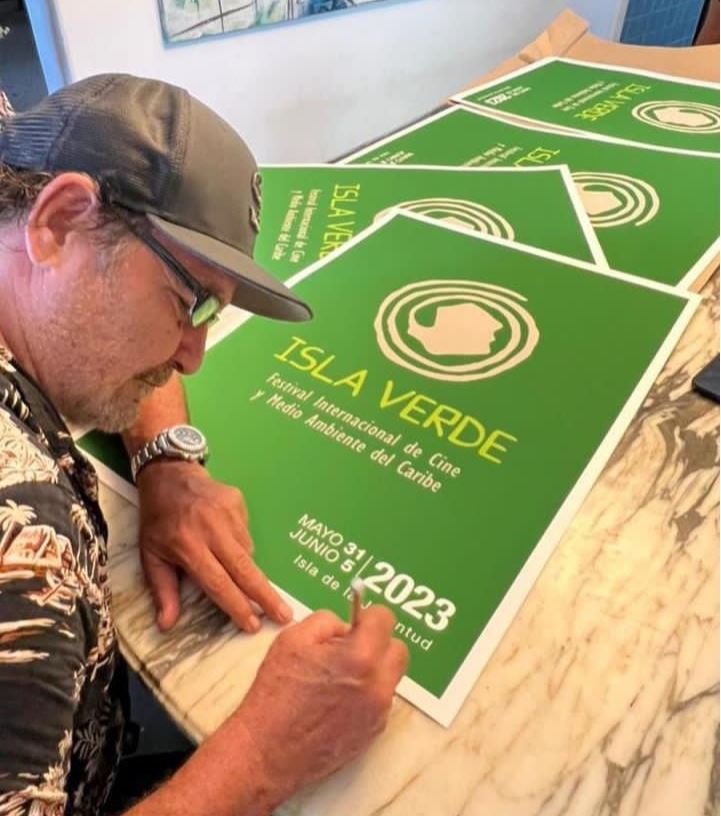
In the face of global concern about climate problems that are becoming more frequent and intense, Pichi has sought ways to raise awareness and appeal to collective sensitivity.
He said his interest in environmental issues was consolidated by his documentary Los Jardines de la Reina (2021), about the reserve (coral reef on southern coast of Cuba) through interviews with the scientists who monitor it, who explained what the advantages of having an ecosystem like that are and the importance of protecting it. “The subject excited me,” he admitted.
“I also narrated the video by Irish director John Murray, entitled ‘Soy Cuba: la indomable’, which is a journey through all of Cuban nature; seeing that more and more actors and filmmakers are contributing to this cause such as Leonardo Di Caprio and Javier Bardem, and the memories of their trips to the island were other motivations.
“When I left the Gibara International Film Festival, founded by Humberto Solás, in charge of Sergio Benvenuto Solás, his grandson, I created Isla Verde, an event with scope to connect with the whole Caribbean region, because all the countries in the area suffer the same consequences of climate change. I chose the Municipio Especial grocery store as the venue because I thought it had the ideal conditions for a forum of this type, and it is very easy for this site to become a benchmark for ecosystem conservation.
“I am happy to contribute to this fight in which we should all commit ourselves because what is at stake is our future.”
Both festivals have required absolute dedication from Pichi in terms of time and energy: “I give everything, it doesn’t matter if it’s daytime, at night or in the early morning… I don’t stop and I know it’s exhausting, but it gives me satisfaction because I learned, from when Humberto founded the Gibara festival, of the importance of cultural events.
“I value and believe in the transformative power of culture and art, because I am the result of that. I didn’t go to school, but I have had the joy of participating in the International Festival of New Latin American Cinema, in the Havana Biennials and in the theatre festivals.
“That’s why I paint, direct, and I’m always involved in projects, but I still love acting first and foremost,” he revealed.
In this maelstrom, Pichi has not been alone, as he has had by his side Elsa María Lafuente de la Paz, wife and mother of his four children: Anthuan, Andros, Adán and Amén Perugorría.
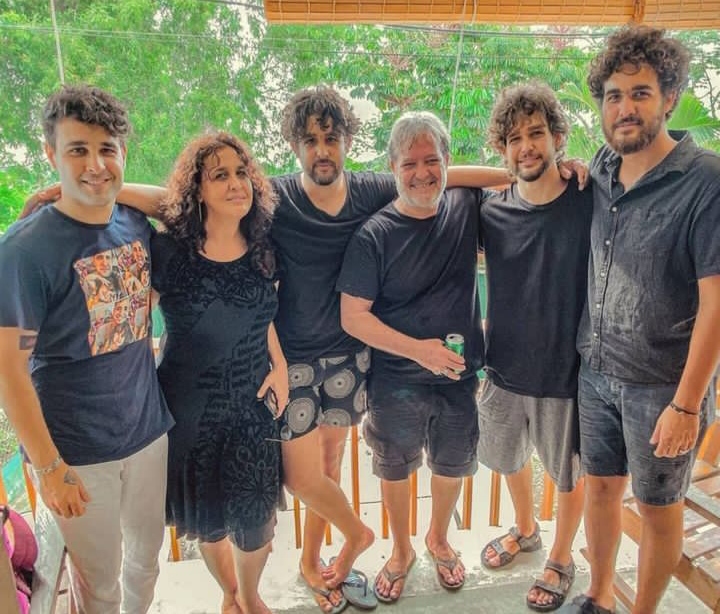
According to the actor, they met in high school and worked in the play Romeo and Juliet, in the Olga Alonso Group. They started their careers together and even their graduation theses.
“She has been by my side accompanying me in all my madness, because I just say: ‘I want to paint’, and there she is – looking for paints and oils.
“She has supported me in every project, and much more so in acting, because since we started she has made a journey with me in cinema. She is the one who supports me, supports my madness and feeds us all,” he says proudly.
Scene 7. The 2024 National Film Award goes to…
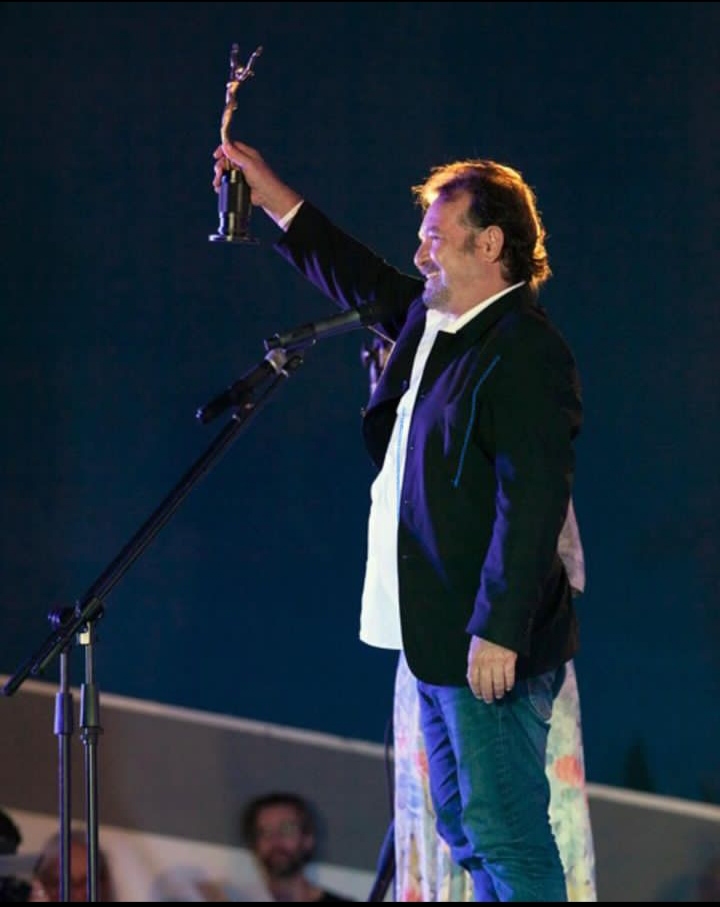
When in March 2024 ICAIC was preparing the celebrations for its 65th anniversary, it was also time to present the National Film Award of the year. The jury decided that the award should go to Jorge Perugorría.
The record of their decision includes factors such as “his national and international work (…) its multiple nominations and awards in all latitudes.”
He also highlights his contribution to the development of national culture, of which he is an indisputable defender. He is one of the most visible faces of his generation and has set a standard in the interpretation of the most diverse characters he has faced.
The jury defined him as “a multifaceted artist who embodies the deepest values of national identity.”
When Pichi is asked if he considers himself as such, he replies with total humility and laughter that it is not for him to say.

“Really, nothing I do is for recognition, but for the deep gratitude I have to Cuban cinema, which opened doors for me internationally, and I will never forget that.”
“Cuban cinema has always been the greatest way for me to express myself and I have always been very proud of it. That gratitude has led me to promote the Gibara International Film Festival, created by maestro Solás, and to found Isla Verde, which are my contributions – to give back as my homeland has given me,” Perugorría said.
“Cuba is the great mother of all us Cubans and we owe it to her, and although for work reasons I am sometimes absent, I try to spend as much time as possible here, in my land.”
He revealed ‘Memories of Underdevelopment’ (1968) as his favourite film. “I would have loved to be Sergio, but who wouldn’t!” he exclaims.
Of those made by him, Strawberry and Chocolate is his favourite, indisputably, because “it marked a before and after in my life and in the history of Cuban cinema.”
“There are other films, some have been seen in Cuba and others have not, that I like, including ‘Guantanamera’, ‘Waiting List’ (2000), ‘The Horn of Plenty’ (2008), ‘Vertical Love’ (1997), and others that I made in Spain and Latin America such as ‘Estorvo’ (1998) which was shown at Cannes, ‘Wall of Words’ (2014), a great experience with Fernando Pérez, and ‘Viva’ (2015), by director Paddy Breathnach, which only just missed a nomination for best foreign film at the Oscars,” Pichi said.
“I’m even proud of the bad films I’ve made because I always work with the same passion and enthusiasm, even if in the end some come out better than others.”
Talking about the National Film Award, for which Pichi points out, he was nominated many times: “I had forgotten that it existed and I thought that they were never going to give it to me until I was older…I thought they would award it to Mirtha Ibarra; Adela Legrá; or José María Vitier, who has composed so much wonderful music for films; Santiago Llapur; and of course, Luis Alberto García or Isabel Santos, who are two iconic actors and shown work more than deserving of such an award.
“The jury chose to give it to me and it was a brave decision, because I am the youngest of those I have mentioned, and it has generated controversy because it is generally awarded to people with a lifelong masterful career and who are very old, who are here today, but perhaps not tomorrow.
“It’s hard to always meet all expectations.”
In his acceptance speech, the artist asked for an environment of reconciliation for Cuban cinema to work together. He called on behalf of the country’s filmmakers and artists, for necessary changes in cultural policy for the collective benefit.
“Cuban cinema is precisely that, the one made by us from wherever we are,” he said.
Final cut
This interview with Pichi has been like shooting a film that its protagonist is still piecing together. Outside the gallery other journalists are waiting and perhaps he will have to, once again, start telling his story. This team ends the interview as if making cinema, when recording the last take, shouts: “it’s a wrap!”
 Cuba 50
You must be logged in to post a comment.