
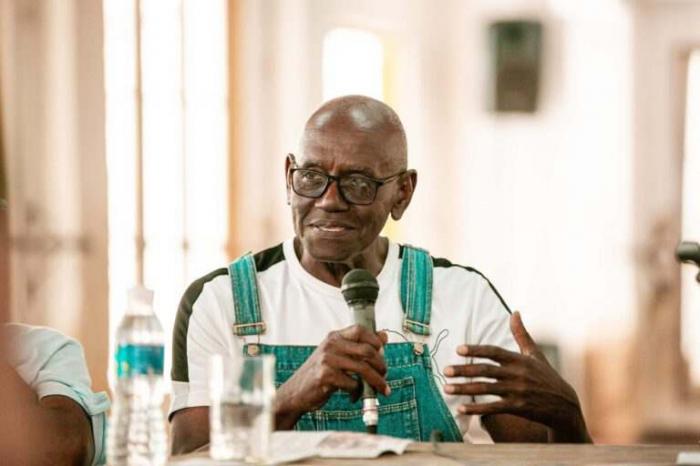
The dancer, choreographer and teacher Alfredo O’Farril Pacheco was awarded the 2024 National Dance Award this April, due to his outstanding work, which has been recognized both in Cuba and abroad, and his significant contribution to Cuban culture.
The jury chose from a shortlist of eight nominees, and decided, unanimously, to award Papá Shangó – as he is known – who for 30 years was part of the Conjunto Folklórico Nacional de Cuba (CFNC, National Folkloric Ensemble of Cuba) as principal dancer. In an interview O’Farril said: I am very happy and grateful to the authorities who decided to give me the Prize and, above all, to the Cuban Revolution. If it weren’t for that, the National Folkloric Ensemble, of which I’m a part, wouldn’t have been created.”
After participating in the Literacy Campaign of 1961, O’Farril joined the amateur group El Nuevo Teatro de Danza, which was sponsored by the CFNC, then entered the CFNC, going from being “a street boy to a member of a professional dance group”.
In addition to training under the influence of masters such as Ramiro Guerra and Rogelio Martínez Furé, and sharing the stage with figures such as Santiago Alfonso, who O’Farril refers to as his eternal teacher, he developed an ascending career as a performer.
From top dance teachers such as Alberto Alonso (ballet), Ramiro Guerra (contemporary), O’Farril says he learned that “dance is one. I say that the proper name is dance, and the surnames are classical, contemporary and folkloric, and you have to study them all as training, and then specialize.”
The CFNC offers its dancers a rigorous comprehensive dance training, including classical technique (ballet) and modern technique, as well as acting classes. “I became a better folk dancer because I learned classical and modern technique.”
As part of that group, O’Farril also taught, and developed the teaching of the dance for more than ten years at the head of the Department of Folkloric Dance, of the University of the Arts (ISA). He was also a founder of ISA’s Faculty of Dance.

O’Farril previously received the Distinction for National Culture and other national awards. He is a member of the Board of Advisors of the National Council for Performing Arts, and of the International Dance Council.
About his career as a dancer, he explained how he came to commit to folkloric dance: “Since I found it so difficult, I had to keep practicing and practicing, and that made me like it, then love it…and I felt: I have to do it”.
“Also, I saw the bearers who did not have the technique that we had, nor the conditions, and they danced it very well; So, I had to dance it as it was, and that got me.”
The role he remembers most fondly is Shangó, which he found a very difficult dance. So he trained very hard and, with constant practice, “Shango got me, I fell in love with that character, and I started playing him. It seems that the public liked it, and they gave me the nickname Papa Shangó.”
He teaches his students at ISA that the dancer does not have to become a musician, but they do have to understand percussion, to know when the drum changes. “Every change that the drum makes, in the orishas (dances) it becomes a different dance. If you don’t know, the drum changes and you keep doing the same step, but when you know how to play, you know the drum changes and the dancer changes the step.”
In order to improve his dance and knowledge O’Farril learned to play batá drums, rumba, guaguancó, and carabalí music, thanks to the friendship he had with one of the greatest drummers in Havana, Jesús Pérez Puentes, whom “I loved like a father and he loved me like a son,” and whose bond opened the doors of the religious world to him.
“I met religious people with a lot of knowledge, who taught me the stories of the orishas, dances that were sung, but not danced. I learned all of that, not in a classroom, but amongst that living library.” O’Farrill also constitutes a living library for his students. “There is no greater reward than for students to stop me in the street, greet me and remember what I taught them. That happens to me frequently, because I have students everywhere.”
O’Farril was asked in a recent interview if you need to be a Santeria practitioner to be a member of the CFNC and answered:
“The dancers have to know the history of this dance, the diverse cultures of the slaves from various parts of Africa who arrived on the island, as well as their orishas. Of these orishas, it is first necessary to know their characteristics in order to give them movement; But religion is not obligatory. I have students who are Catholic or have no religion. I, for example, am a santero and a Catholic, and I go to church on Sundays. That is part of Cuban syncretism, syncretizing the orishas with the Catholic saints…When you talk about folklore, many think that they are African dances, Santeria, but folklore is also made up of danzón, danzonete, cha-cha-cha, Cuban footwork, among other traditional Cuban dances.”
When asked about his comment in the past about the CFNC becoming stagnant he said:
“Folklore is made by the people and the people are always evolving and creating. What people feel when they are in a drum beat, that essence has to be transmitted on stage, but [for a while] the CFNC remained stagnant in the dances of Yemayá, Eleguá, Shangó, for example. Leiván García (the current director) has set the folklore machinery in motion again.”
Based on reports in Granma Cuban press here and here
About folkloric dance and the CFNC
The Conjunto Folklórico Nacional de Cuba was founded after the Revolution in 1962 to preserve the African/Afro-Cuban/Cuban art of dance and music. It brought ritual dances into a secular setting and in choreographed versions on national stages. It laid the foundation for a new Cuban identity and was important to strengthen the African culture of the island as a part of national heritage. Contemporary productions always had a focus on folkloric elements and the history of the island.
The fusion of European-Spanish traditions with African elements is well-known for popular dances, such as salsa, son, bolero, danzón or cha cha chá. Over the centuries of the trans-Atlantic slave trade, different ethnic groups from West and Central Africa arrived. Some of them re-established themselves in “cabildos de nación”, mutual-aid societies. Their dances, drums and languages with specific origins became a part of Cuban culture. Many are practiced in the sphere of religious and ritual communities, like santería, palo, arará or abakuá, others are secular, like rumba, conga or tumba francesa.
Read more here
 Cuba 50
You must be logged in to post a comment.