
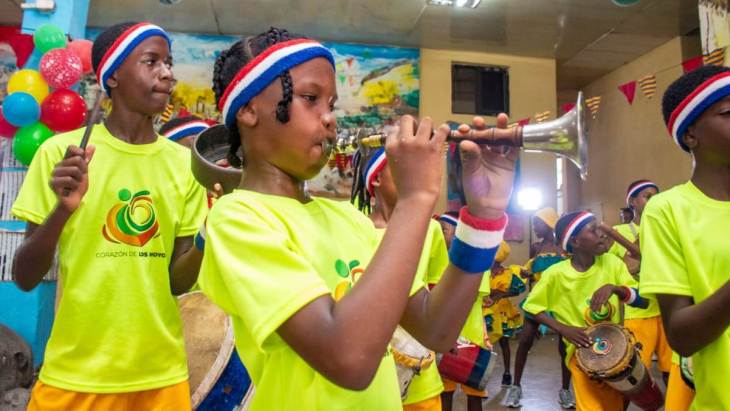
It’s July, it’s Santiago de Cuba. With the highest mountains on the island as a backdrop, the city stirs, and reveals itself to the sound of drums and corneta china (Chinese horn). Drink a pitcher of beer against the intense heat, absorb the symphony of life.
It’s the carnival that performs the miracle of melting everything, of embroidering difficult moments with its contagious joy. “That which rises, that which comes. That which shakes the earth, is Carnival,” once confessed the unforgettable maestro Enrique Bonne (1926-2025), creator in 1961 of the largest group in Cuban popular music, Los Tambores de Enrique Bonne.
Winner of the National Music Prize in 2016, the composer spent nearly three decades leading the parade of one of the country’s most famous celebrations. The braided fan he held in his hands became an emblem, a sceptre, and a symbol. When he moved it, Carnival moved. The celebration was often the focus and inspiration for his songs:
If they told me that the day would come
that Carnival would die in the East
it would cause a tremendous mess in Cuba
because without rumba I cannot exist
(“Si me faltara el carnaval,” Enrique Bonne)
Declared ‘Cultural Heritage of the Nation’ 10 years ago, the Santiago Carnival is a people’s carnival, a participatory, open, and walking celebration. That’s its hallmark. It has also been dubbed “the biggest party”. Up and down Trocha and Martí, people flood the city’s main arteries. It has never been a luxurious carnival: luxury is its atmosphere, its tradition.
Dr. Olga Portuondo Zúñiga, Historian of the City of Santiago de Cuba, points out that the contemporary carnival is the result of “several secular and religious festivities that, over the course of decades, intertwined, remade, and grouped together on specific dates, forming what we recognise today.”
It’s difficult to find a single image that typifies the Santiago carnival, amid so much colour, sweat, and passion; a place perhaps somewhere between La Placita, San Agustín, and Los Hoyos. All in constant renewal. What seems to be unanimous is the fact that, if one were to summarize the sound of carnival, the corneta china (Chinese cornet) would rank highest. Its first performer was not an improviser, but a trained musician, Juan Bautista Martínez. It is said that the event took place in 1915 in the neighbourhood of El Tivolí.
“The first thing you need to have to play the corneta china is good rhythm and a sense of what the music is. The rest is about the embouchure, which is different from other wind instruments. For us in Cuban music, it is a bit difficult to get the flats, sharps, and semitones with the Chinese cornet. You have to blow hard, you have to find the notes with the capacity for air, regardless of the instrument’s tuning.”
The man who speaks with such authority is the legend, Joaquín Emilio Solórzano Benítez, who has developed his own method for playing the instrument: formal learning and practice on the street. He was practically born inside a conga parade, in the Alto Pino neighbourhood, and since 1974 has pursued a career with the corneta china, developing an unmistakable style performing with the San Pedrito conga and other distinguished carnival groups.
His in-depth study of the instrument, combined with his musical versatility, has led him to also perform with symphony orchestras, travel the world alongside icons such as Eliades Ochoa and Compay Segundo, and participate in albums and recordings. At 75, he has established himself as a defender of the legacy represented by Los Tambores de Enrique Bonne, the group he directs, and shares his experiences as a percussion professor at the Esteban Salas Conservatory in his hometown of Santiago. Awarded the Living Memory Prize by the Juan Marinello Cuban Institute for Cultural Research in 2017, when Joaquín speaks, you have to listen: “The corneta china arrived at a crucial moment, it began to replace the interplay of soloists singing something and the crowd responding, as they swept through the streets during Carnival. The corneta gradually took over the conga parade and gave it a different tone. Today, it is a distinctive instrument of Santiago de Cuba.”
When the corneta china sounds, the signal is unmistakable. It is a call to the living and the dead. There’s no more to it. It’s July, it’s Santiago, it’s Carnival.
Original article in Spanish from Cubahora.cu
Get a taste of the corneta china as played by Joaquín Emilio Solórzano with a conga group on the streets of Santiago de Cuba
More about the Carnival
Carnival in Santiago usually runs 21-27 July each year, incorporating the national holiday 25-27 July. It consists of many elements beginning with the invasions by conga groups from different neighbourhoods during the daytime when everyone comes out in their ‘chancletas’ (flipflops) to dance behind. The muñecas (‘big heads’ dancers) parade then the children’s groups and then the parades proper begin – congas, comparsa congas (with dance groups) and paseos (big dance groups), and floats.
The celebrations come to a halt at midnight on July 25 to remember the anniversary of the 1953 assault on the Moncada barracks in the city, led by the leader of the Cuban Revolution, Fidel Castro, and a group of young revolutionaries, who used the carnival activities as cover for their attack.
Watch the children’s parades in this carnival July 2025 direct from Santiago
 Cuba 50
You must be logged in to post a comment.