
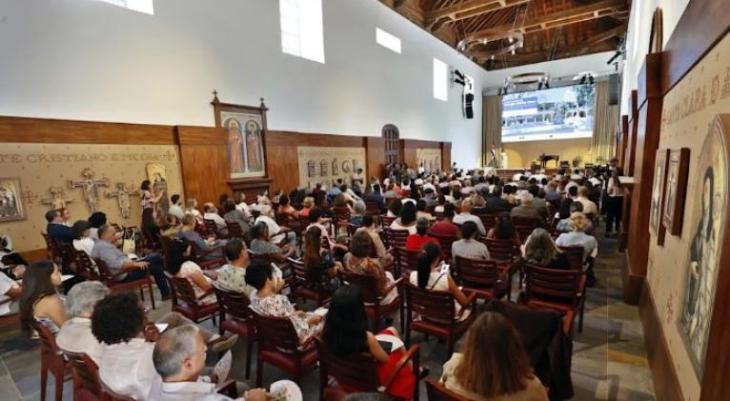
The Colegio de Santa Clara, an institution for the training of young people from Cuba and the Caribbean in the arts and crafts of restoration, was inaugurated in April at the former headquarters of the convent of the Santa Clara order in the historic centre of Havana.
This cultural project is the result of cooperation between the Office of the Historian of the City of Havana (OHCH), UNESCO’s Transcultura programme and the European Union (EU), which contributed more than four million dollars to rehabilitate the building (almost four centuries old) and the Italian Agency for Development Cooperation.
Cuban President Miguel Díaz-Canel and other senior government officials attended the ceremony that inaugurated the first stage of the project in one of the four cloisters of the seventeenth-century building.
The EU ambassador to the island, Isabel Brilhante, stressed that the cultural link with the Caribbean is “strategic” and “not only strengthens” bilateral relations, but also projects “a shared vision based on talent, innovation and respect for our identities.”
She affirmed that the Colegio de Santa Clara celebrates “a concrete step in that direction”, that “this monumental complex becomes a model of creative conservation that inspires other regions” and considered that “Europe has a lot to offer, but also a lot to learn from dynamic contexts such as the Caribbean”.
For her part, the director of the UNESCO Regional Office, Anne Lemaistre, stressed that “Santa Clara stands as a symbol of resistance and rebirth,” a “collective legacy to the Caribbean and the region” and a “beacon of hope for new generations.”
The new educational and cultural centre is conceived as a multifunctional institution that will offer courses and teaching in the field of conservation, restoration and management of heritage in its classrooms, laboratories and conference room.
The 12,300-square-metre venue has a museum and its promoters plan to create a Aula Magna for international events, exhibition halls, a library, multipurpose rooms, laboratories and studios for art-related activities of all kinds.
It is expected that young students will learn in this college of arts and crafts about the use of wood in Caribbean architecture, the preservation of cultural heritage, photography as a tool for the conservation and rehabilitation of heritage buildings.
A building with history
The religious enclosure, founded in 1644, was built to house the cloistered order of the Poor Sisters of Santa Clara, known as the Poor Clares, the largest and first female convent or established on the island.
The enormous two-storey construction, thick walls and façade with high towers, came to have three cloisters, a church, refectory, kitchen, infirmary, orchard and the necessary facilities for a community of one hundred nuns.
The Poor Clares lived there until 1922 when they sold it to a real estate company and moved to another neighborhood of Havana.
Three years later the monastery became the headquarters of the Ministry of Public Works and, after the triumph of the revolution in 1959, it housed different institutions, including the National Center for Conservation, Restoration and Museology.
Finally, in 2012 the property passed into the hands of the Office of the Historian of Havana, which was then in charge of Eusebio Leal, a leading figure in the recovery of the architectural heritage of the Cuban capital.
He was the one who launched shortly before he died in 2020 the rehabilitation project of the old convent of Santa Clara, a key piece of the historic center of Havana, declared a cultural heritage of humanity in 1982.
 Cuba 50
You must be logged in to post a comment.