
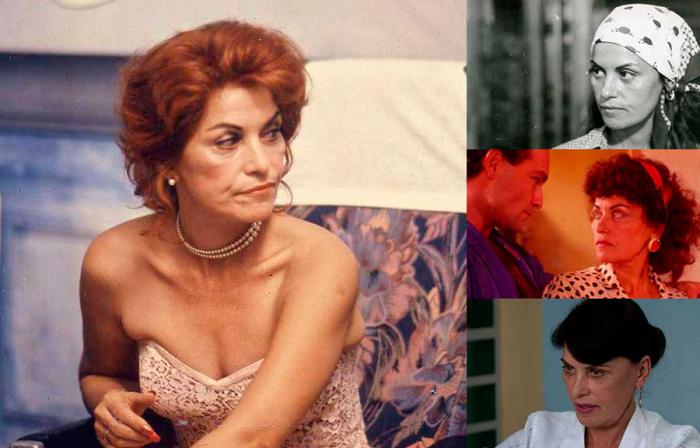
This March Mirtha Ibarra, internationally famous for her roles in popular movies ‘Strawberry and Chocolate’ and ‘Guantanamera’, received the National Film Award, the most prestigious annual award for contribution to culture in Cuba.
The jury said she has performed “not only as an actor in iconic films since 1967, but also for her many roles in national cinema and culture over more than 50 years…the impact of her work on Cuban society, and her work preserving the legacy of Tomás Gutierrez Alea.”
“I always enjoyed taking on transgressive, feminist characters”
In an interview with Cuban culture magazine La Jiribilla for International Womens Day, Mirtha said “Although Cuban women have been gaining spaces in our society and demonstrating their ability to take on many responsibilities, no matter how difficult and complex they may be, achieving important and great conquests, there is still, however, much to be done.
“It is a reality that some things inherited from the past still persist, such as machismo and violence against women. And in that sense, cinema plays a very significant role in the creation of films that openly address these issues. Particularly in my case, I always enjoyed taking on transgressive, feminist characters.”
Although she is mostly identified with cinema, Mirtha Ibarra began her successful artistic career in theatre. “Shortly after graduating from the National School of Art, I was part of the Young Theatre group… Later I joined other groups such as the Bertolt Brecht Political Theatre and Studio Theatre, where I remained for a long time. I played several characters in emblematic works that led to me to winning my first awards.
Mirtha’s performances in dramas and soaps on Cuban TV are also significant, such as The Man Who Came with the Rain, I Will Wait for You to Grow Up and Shiralad, “which I remember perfectly because I had to play a witch who was constantly changing.”
When did you become a film actor?
“In 1973 I began my relationship with (film director) Tomás Gutiérrez Alea, ‘Titón’, and three years later ─I always say looking for a pretext to spend more time together─, he invited me to the set of his film The Last Supper. Suddenly he gave me a part, small really because it was the foreman’s wife, but which ultimately became my debut in the cinema.

“It didn’t take long for me to take on a leading role for the first time in the film To a Certain Point (Tomás Gutiérrez Alea, 1983). It was precisely with that character that I won the Best Actress Award at the Havana International Festival of New Latin American Cinema in 1983 and the film won the Grand Prize.
“Later on I worked with other directors such as Daniel Díaz Torres, with whom I had the honor of participating in the film Otra mujer. Again with Titón we filmed Cartas del parque and with Gerardo Chijona Adorable Lies, where the character of Nancy began to evolve, which was later addressed in much more depth in Strawberry and Chocolate.
“I was also in Guantanamera and then I made some other films sharing roles with Jorge Perugorría. Among them Fatima or The Fraternity Park, Se vende, and I also participated in several films made by foreign filmmakers.
In reality, there are so many names of films, directors and characters that they would not fit in a single interview. Although if I had to highlight one in particular, I would say that I admire To a certain point and Adorable Lies, for which I received very good reviews.”
And if you had to choose, which would you choose between theatre, television or cinema?
“At all times and always, always the cinema. In my opinion, not only artists but all human beings seek in some way durability, immortality, if it really exists. And it certainly exists in the work they leave. A sculptor, for example, in the creation of his best sculpture, an actor in his most relevant characters, a director in his most applauded films. Even today we continue to admire, for example, Betty Davis, Charlie Chaplin and Joan Crawford, who passed away a long time ago and continue to be remembered and loved all over the world because they left a very solid work.”
The great talent, versatility and absolute dedication to her profession of this multi-award-winning actress, has led to her performances in more than twenty films. However, it was the character of Nancy in the iconic film Strawberry and Chocolate by renowned filmmakers Tomás Gutiérrez Alea and Juan Carlos Tabío, “the one that made me known worldwide, the one that has most marked my life and my professional career in the international arena.”

Throughout her brilliant artistic career, Mirtha Ibarra has ventured into both drama and comedy. In which of these genres have you felt most comfortable, most professionally fulfilled?
To tell you the truth, in both. I didn’t know that I was capable of doing comedy, but it happened that one day, in the play Tema para Verónica, while I was rehearsing, I noticed that Eugenio Hernández ─that extraordinary director─, was laughing along with the assistant and other people. I approached him and asked him why he was laughing. He replied that I had actually done a very nice scene. Then I realized that I could also do comedies.
Even though cinema fans can no longer admire you in new film productions, you have not definitively separated yourself from the big screen. What projects are you currently working on?
We are in the process of editing a film that is the adaptation for the cinema of a play I wrote, called Anonymous Neurotic. It was made with the collaboration of Jorge Perugorría. Its premiere is scheduled in the context of this year’s International Film Festival; although we have thought of making it known before at the San Sebastian Film Festival, Spain. And now I’m writing another script. It is a comedy that I am very enthusiastic about and to which I gave the name of Si se enteran.
On the other hand, my attention is also occupied by the activities at the Casa de Titón y Mirtha Cultural Centre, a wonderful gift from Eusebio Leal in the neighborhood of San Isidro, in Old Havana, which is already close to celebrating its fifth anniversary.
As regards previous awards received, Mirtha commented “UNEAC has awarded me several. I received the Gitana Tropical Award, the Order for National Culture, the Félix Varela medal, Doctor Honoris Causa from a English Mexican university pus many other awards in international and national events and festivals.”
What is your message to a new generation of actors?
“That they watch a lot of cinema not simply as spectators, but from the point of view of reflection and analysis of each scene, of each character. Let them read as much as they can. That they never think that they have learned everything, that they know everything. That they make study of self-improvement a primordial, daily task.
“I believe that actors have to be above all cultured people. Only by being more and more cultured will they be able to be better actors and strengthen something as important and necessary in these times as ethical and moral values.”
Based on the interview published by La Jiribilla March 8, 2025 – original report here
Mirtha Ibarra (b. San José de las Lajas, Cuba, February 28, 1946) is an actor in films, theatre and television, and a graduate of the National School of Art of Cuba and a graduate in Latin American Literature from the University of Havana.
Filmography
The Last Supper (1976), by Tomás Gutiérrez Alea
Se permuta (1983), by Jun Carlos Tabío
To a certain extent (1983), by Tomás Gutiérrez Alea
The Steps to the Mountain (1984), by Juan Vilar (TV Series)
The Man Who Came with the Rain (1985), by Miguel Sanabria (Telenovela)
Plácido (1986), by Sergio Giral
Dolly Back (1986), by Juan Carlos Tabío (Fiction, Short Film)
Another Woman (1986), by Daniel Díaz Torres
Cartas del parque (1988), by Tomás Gutiérrez Alea
Julia (1990), by Mayra Vilasís (Short story from the film Transparent Woman (1990)
Adorable Lies (1992), by Gerardo Chijona
The Triangle (1990), by Rebeca Chávez
I Will Wait for You to Grow (1990), by María Elena Espinoza (TV Series)
Shiralad (1992), by José Luis Jiménez (TV Series)
Knocks on My Door (1992), by Alejandro Saderman
Strawberry and Chocolate (1993), by Tomás Gutiérrez Alea, Juan Carlos Tabío
El plano (1993), by Julio García-Espinosa
Guantanamera (1995), by Tomás Gutiérrez Alea, Juan Carlos Tabío
Ilona Arrives with the Rain (1996), by Sergio Cabrera (Cuba-Colombia)
Mararía (1998), by Antonio Betancourt
Havana Quartet (1998), by Fernando Colomo
I Will Survive (1999), by Menkes-Albacete
Roulette (1999), by Roberto Santiago (Fiction, Short Film, Spain)
Sagittarius (2000), by Vicente Molina Foix
Quia (2001), by Silvia Munt
People Who Cry S.A. (2001), by Hatem Khraiche (Fiction, Short Film, EICTV)
Although You Are Far (2002), by Juan Carlos Tabío
Laura’s Truth (2002) (TV Series, Spain)
Any Woman (2004), by Tamara Morales (Documentary)
The Fog in the Palm Trees (2006), by Lola Salvador, Carlos Molinero (Documentary)
Homo Sapiens (2006), by Eduardo del Llano (Fiction)
The Horn of Plenty (2008), by Juan Carlos Tabío
Titón, de La Habana a Guantanamera (1928-1996) (2008), by Mirtha Ibarra (Documentary, Director)
7 Days in Havana (2011), by Benicio del Toro, Pablo Trapero, Elia Suleiman, Julio Medem, Gaspar Noé, Juan Carlos Tabío, Laurent Cantet
Se vende (2012), by Jorge Perugorría (Fiction)
Chronic Love (2012), by Jorge Perugorría
The Game (2013), by Antonio Hens (Fiction, Spain)
Fatima or The Park of Fraternity (2014), by Jorge Perugorría
Dancing with Margot (2015), by Arturo Santana
Anonymous Neurotics (2015), by Mirtha Ibarra, Joel Angelino (Fiction)
Mirtha (2017), by Lourdes Prieto (Documentary about her life and work)
Anonymous Neurotics (2025), by Jorge Perugorría (Fiction, screenplay and acting)
 Cuba 50
You must be logged in to post a comment.